


Stand Up Paddle Board
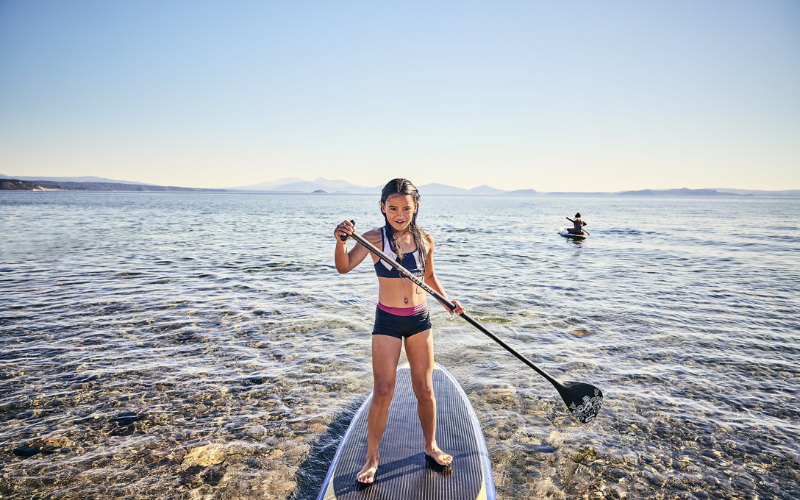
Stand up paddle boarding is a safe, fun and low impact sport that helps to improve balance. When you are just starting out to stand up paddle board, you may experience some muscle ache in your legs, but you know how satisfying that can be after a good workout, right? Using a stand up paddle board a few times a week will help you stay happy and healthy. It will improve not only your physical health but also your mental health. In this article you will find everything you need to know to confidently stand up paddle board.
How to stand up paddle board?
Here at Motutere Bay TOP 10 Holiday Park, a lot of our guests who rent one of our stand up paddle boards are about to experience the activity for the first time and are genuinely interested in how to stand up paddle board. That made us come up with this article to give you some basic, simple and very useful tips for everyone who would like to get on a stand up paddle board and give it a go.
You may think that the instructions on how to stand up paddle board go along the lines of: “Get on the board, stand up and paddle. If you fall in the water, you did it wrong and try again.” But we are aware that there is more involved than just jumping on the stand up paddle board and taking off.
The topics we will cover are:
- Is stand up paddle boarding hard?
- What size stand up paddle board should I use?
- How to handle a stand up paddle board?
- What is the correct way to stand on a paddle board?
- How to handle the paddle?
Is stand up paddle boarding hard?
The short answer is – no, it’s not. The longer answer would be – it is as hard as you make it. So let’s go through some important things to make your stand up paddle board experience more enjoyable and not too hard.
Before you even start paddle boarding, there are some things to keep in mind.
- Always wear the leash around your ankle to ensure you will be able to get back on the board in case you do fall in the water.
- We advise you to wear a life jacket, just to have that one extra box ticked off for your own health and safety.
- When stand up paddle board keep away from shallow reefs and rocks, as well as be mindful of the wind.
To make your stand up paddle board experience more pleasant, especially if you are not experienced, try to paddle upwind first, as that will make coming back to the shore easier. You don’t want to realise far in the middle of the bay, lake or worse – ocean, that getting back is going to be a struggle. When stand up paddle boarding, just like with any other recreational water sport activity, let others know what you are doing, as well as keep close to the areas where people can see you, so if help is needed, they can promptly provide it.
What size stand up paddle board to use?
It may seem that one size fits all, but it’s not the case. Turns out it is crucial to consider different factors when choosing your stand up paddle board. Your body type (weight and height), your experience level, your intention for the future as well as where you are planning to paddle board.
This time we will focus on how to choose the stand up paddle board for the beginners. The best is to use a board that corresponds with your body weight – volume of the board should be twice as much as your body weight. For example, if you weigh 70kg then your stand up paddle board volume should be ~140 litres. That will ensure that the rails of the board will be about half way in the water which will provide better stability. If you have a board that has too much volume, it will be too much out of the water which then makes it less stable. If you are choosing one stand up paddle board for the whole family, make the decision based on the tallest and heaviest family member.
But volume is just one thing to consider, the other is width. For the beginners we suggest using wider boards as they will give more stability, while narrow boards will tip more. Though if you are after some speed, choose a narrower board as they glide faster. You just really need to work on your balance first.
If we do talk about the length of the stand up paddle board, size does matter. Longer stand up paddle boards will glide better and faster, while the shorter boards are more manoeuvrable and used for surfing. For those who are just starting out stand up paddle boarding, don’t get the high performance surfing stand up paddle boards, go for something in between.
Remember, as a beginner you want a stand up paddle board that will give you more stability, so the suggestion is to go for fuller outline boards with rounded nose and tail and wider rails, and wider board in general. The turns in these may be a bit slower, but they will be much softer and more stable.
How to handle stand up paddle board?
To make sure your stand up paddle board lasts and doesn’t get damaged, as well as your back doesn’t get hurt, it is important to handle the paddle boards in the right way.
- To start using the stand up paddle board, lift it up away from you onto the rail first and then grab the handle and lift the paddle board up. When putting the paddle board in the water, make sure the fins are in the water and the board is floating, not touching the sand, as you don’t want it to get damaged.
- To get off the paddle board, get to the shore line, but make sure you are still floating and not touching the ground with the paddle board. When you are in knee high water, get on your knees, put one foot in the water. When you reach the bottom, take the other foot down. Then just like in the beginning, lift the paddle board up away from you, grab the handle and carry it out. Don’t slide with the paddle board onto the beach as that can break the fins and damage the board itself.
What is the correct way to stand on a stand up paddle board?
After you have got the paddle board in the water, get on to the stand up paddle board first on your knees. Make sure to put your knees on either side of the handle, as that will ensure you are evenly in the centre of the board and it is flat on the water surface.
Take some strokes while being on your knees, to feel the paddle and adjust your balance. To stand up on the board, put your paddle in front of you across the board, hold hands on the paddle, and then put your feet right where your knees were. You don’t want to be too far forward or backward. Being too far forward may make your nose of the board sink or lift the tail out of the water. If you are too far back, the tail is sinking and you are kind of dragging through the water. You want the board to be flat on the surface so once again – keep your feet spread apart on each side of the handle.
It is important at this stage not to crouch or lean forward facing the water, as that’s not going to do any good for your balance. Make sure you keep the paddle in the water, stand straight, chest forward, look at the horizon or at something stable – that will help with the balance.
How to handle the paddle?
Hold your paddle with one hand on the grip of the handle, the other on the shaft of the handle. Ideally you want to hold your paddle pretty far apart. When you switch your arms, make sure to keep them on the paddle in the same heights, to ensure even pressure on both arms during your paddle boarding.
Holding paddle in diagonal too far away from the board makes your board to turn, which is good to keep in mind, but if you want to go forward, which I bet you want, you need to hold your paddle vertically and pull it back in a straight line close to the stand up paddle board.
Lots of beginners think that it’s going to be more efficient if they hold the blade of the paddle angled backwards. It gives a false feeling that you are scooping more water, but the truth is that you are actually pulling the water up.
The correct way is to hold your paddle blade angled forward away from you, even though at first it may not seem right. By holding it this way the blade angle lifts and projects you forward, that way you can get more power from your stroke.
While stand up paddle boarding, reach forward with your paddle, get the whole blade (yes, the whole blade not just the tip of it) in the water and end the stroke at your feet. You don’t want to start the stroke next to your feet and pull the paddle back behind you, as you are just wasting your energy by throwing water up instead of pushing yourself forward.
Remember, your paddle is your walking stick, keep it in the water to balance yourself. It doesn’t help you when it’s up in the air.
Where to get a stand up paddle board?
If you are really keen to stand up paddle board on a daily basis, go to the specialised shops that will help you to choose the best suited option for you, but before making a purchase, we would recommend you to rent one and try it out first.
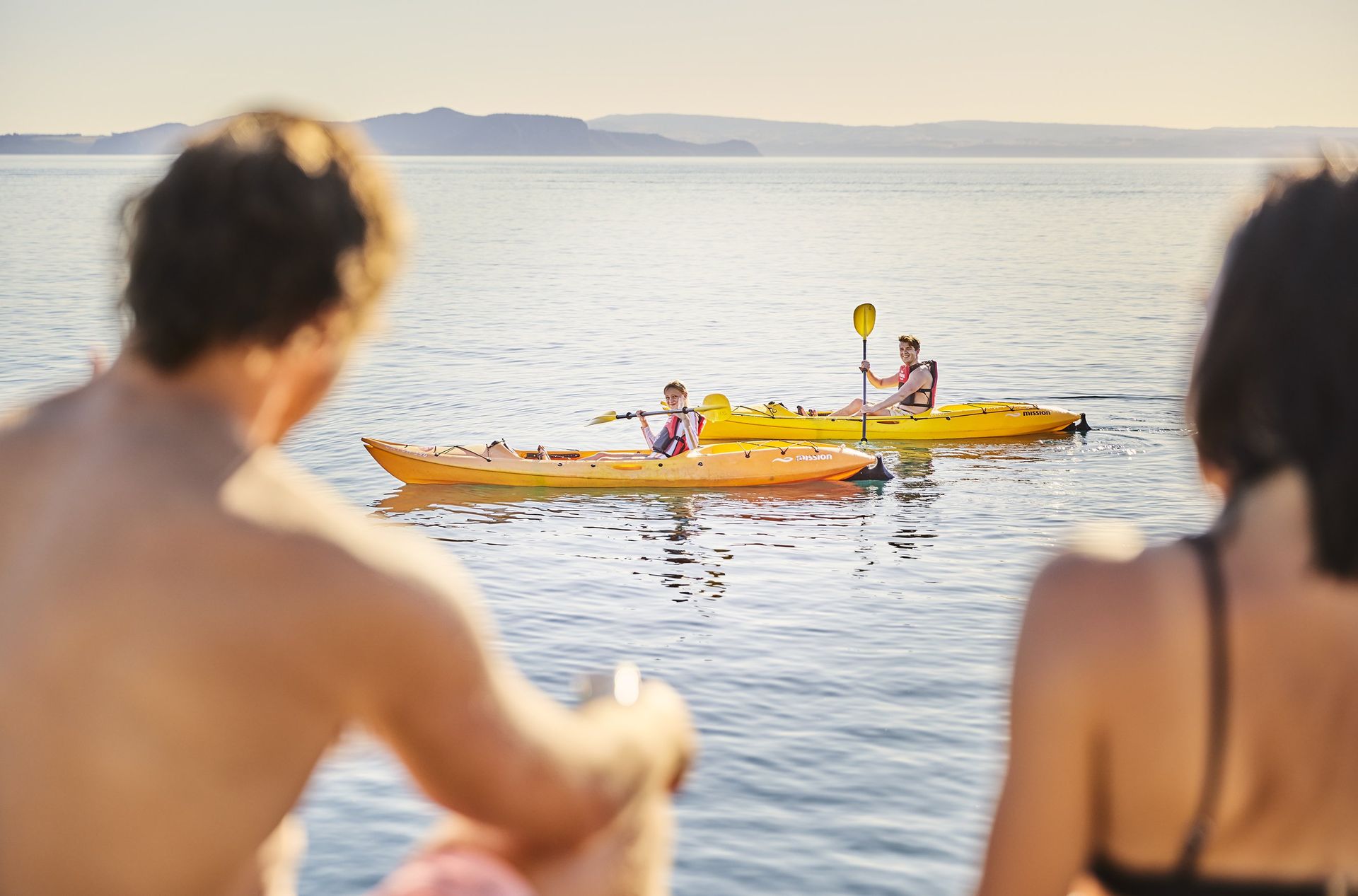
One of the options in Taupo is at Motutere Bay TOP 10 Holiday Park, where you can rent kayaks and sup boards whether you are a guest or would just like to go for a paddle in Lake Taupo. They have available 2 beginner-friendly stand up paddle boards.
Get in touch with the reception at info@laketaupotop10.co.nz or call on 0800 668 229.