


Photo Credit: Love Taupō
Discovering New Zealand’s Heritage: Māori Rock Carvings
The Māori Rock Carvings that symbolize a more than 800 year old event are renowned as the most extraordinary contemporary artwork in New Zealand and are one of the must-see attractions in Taupō. Read this blog to understand why.
Māori Rock Carvings
In New Zealand, you will notice that carvings are an essential part of Māori culture and New Zealand’s heritage. This renowned Māori practice is surrounded by tapu (beliefs) and traditional customs also in modern New Zealand. You can find beautiful creations not only in the souvenir shops but in architecture, art, local Kiwis’ jewellery etc.
Traditional Māori carvings have something distinctly unique from the typical Polynesian style, which is thought to be due to the distance. Designs usually have been carved into wood, stone and the sacred ponamu (greenstone).
From the many legends and beliefs that are carried into today, we have learned that Māori ancestors are known as very religious and spiritual, and carving was an important part of spiritual activities as it was believed that the carved object was used as a vessel for the gods or spirits during rituals. Even more so, the material that was used for carving, tools and the carver itself always was considered sacred (tapu).
Māori have passed on their skills and knowledge through generations so we are able to see and admire traditional creations also in modern New Zealand.
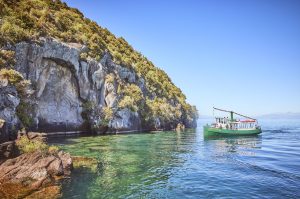
When visiting Taupō there are a few things on the must-see list, and one of them definitely is Māori Rock Carvings. A lot of people, when they first time hear about these carvings, think that they have been overlooking Lake Taupō since the first iwi settlement many years ago, but to their surprise, these Māori Rock Carvings are way more recent.

Photo Credit: Love Taupō
The Māori Rock Carving meaning
After finishing 10-year training as a carver, Matahi Whakataka-Brightwell was asked by his grandmother, Te Huatahi Susie Gilbert of Ngati Rauhoto, Ngati Tuwharetoa, Ngati Maiotaki and Ngati Whakaue, to create a likeness of their ancestor Ngatoroirangi – a visionary Māori navigator who guided the Tūwharetoa and Te Arawa tribes to the Taupō area, to create a permanent connection for her family to the land.
Matahi was inspired by this idea and not only he carved the likeness of Ngatoroirangi, but also 13 smaller carvings that are on the surrounding rocks that are portraying the ancestors (tupuna) and guardians (kaitiaki) of the local Māori tribe.
To acknowledge the multi-cultural nature of New Zealand, Matahi included also two smaller carvings of Celtic design, which depict the freezing south wind Ngatoroirangi stopped and a mermaid.
The main carving has a central line, which represents the celestial side of this being, as well as you can see the third eye or spiritual eye that connects this being to mother earth. His lip tattoo means “shooting star”, to symbolize him as a descendant of the Star God and the eagle wing under his lip symbolizes how he was supposed to fly from one location to another.
When looking at the whole cliff and taking in to account also smaller carvings, you will see 4 lineages making up who Matahi is.
History of The Māori Rock Carving
The Māori Rock Carving was never planned to be an iconic tourist attraction, but due to its significance to Māori culture and its uniqueness, the carving has had its fame since created in the 70s.
The 14m high carving accompanied by smaller carvings around it was carved over the course of four years from 1976 until 1980 by traditional marae-taught carver Matahi Whakataka-Brightwell and 4 assistants – Te Miringa Hohaia, Steve Myhre, Dave Hegglun and Jono Randell – as a gift to Taupō.
What is really interesting, is that originally Matahi wanted to create something out of a totara tree, but as there was none available, he went onto the lake to get some inspiration as he always has been feeling close to the water, attributing it to his ancestral links. And to his luck, he came around the Western Bays and at the Mine Bay he noticed the alcove and instantly felt a connection to it and knew that it shall be the canvas for his intended work.
There were many sketch plans, but the main thing carvers had to get done before starting, was to clear the cliff face and get it to level. After that Matahi used a string line to map out the drawing. It was a long project for which none of the artists got paid because it was a gift from them to the locals and township. The only payment that was taken was donations to cover the cost of the scaffolding that allowed to create the carving in a safe way.
During the process Matahi was purpose-driven, and even though there were many people telling him to stop for various reasons, he carried on in a very detail-oriented way. Matahi has said: “As the descendant of Ngatoroirangi I had to present him in perfection or don’t do it at all.”
The carver of the Māori Rock Carving
Matahi Whakataka-Brightwell is a traditional marae-taught carver and actually one of the last ones who has been trained like this.
When he came to Taupō back in 1976, he had just completed his 10-year training period with Māori elders and was full of inspiration to give back to his ancestors by creating something lasting and beautiful due to his passion for his Māori heritage.
Matahi is a 27th-generation descendant of Ngatoroirangi – a visionary Māori navigator who guided the Tūwharetoa and Te Arawa tribes to the Taupō area over a thousand years ago.
But Matahi Whakataka-Brightwell is well known not just as the creator of the legendary Māori Rock Carvings but also known as the “father of waka ama” as he is the one who founded the sport of competitive racing of traditional Polynesian canoes (waka am) in New Zealand. This happened after his journey in 1985 that replicated Māori migration from East Polynesia to New Zealand back in the 14th century, which he did in his double-hulled canoe he built especially for this trip.
Getting to the Māori Rock Carving
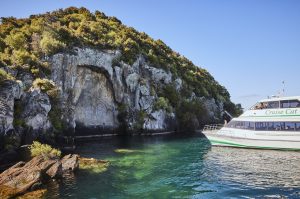
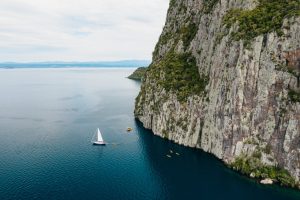
The Māori Rock Carvings are located in Mine Bay on Lake Taupō and as they are accessible only from water, it gives an even more special feel to it.
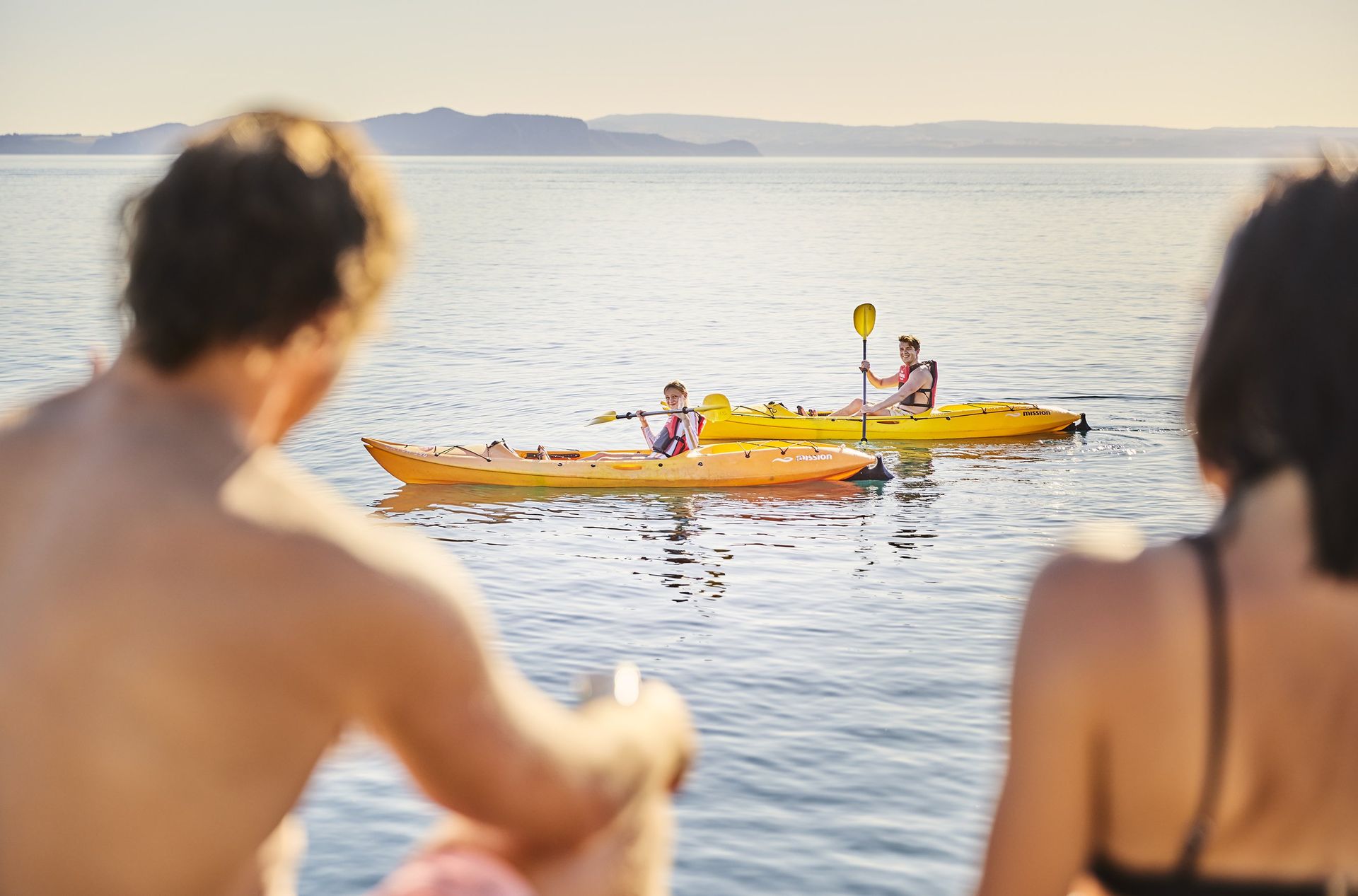
The Māori Rock Carvings location is a great excuse to hire a kayak if you want to have a real close-up look as well as if you are more into some adventure.
There are some local guided kayak tours too, so you don’t miss out.
But if you prefer a relaxing trip, check out the TOP10 membership deals and book Taupō Sailing Adventure to enjoy the comfort of the boat, admire the pristine waters of Lake Taupō, sip some tea and listen to guide commentary that goes into detail about the Māori Rock Carvings.
Get in touch with us at info@laketaupotop10.co.nz or call on 0800 668 229 and our reception staff will be more than happy to suggest the options but know – whatever you choose, you will have an unforgettable experience.